POLICYHOLDER FAQ
Your Workers’ Comp Audit Questions, Answered
Two common questions from policyholders — with the policy language and a plain-English explanation.



Two common questions from policyholders — with the policy language and a plain-English explanation.
Lowry & Associates, Inc. — Now part of ReSource Pro. Service you can depend on, from partners you trust.
In most policies in most states, Part Five — Premium, Section G states:
G. Audit
You will let us examine and audit all your records that relate to this policy. These records include ledgers, journals, registers, vouchers, contracts, tax reports, payroll and disbursement records, and programs for storing and retrieving data. We may conduct the audits during regular business hours during the policy period and within three years after the policy period ends. Information developed by audit will be used to determine final premium.
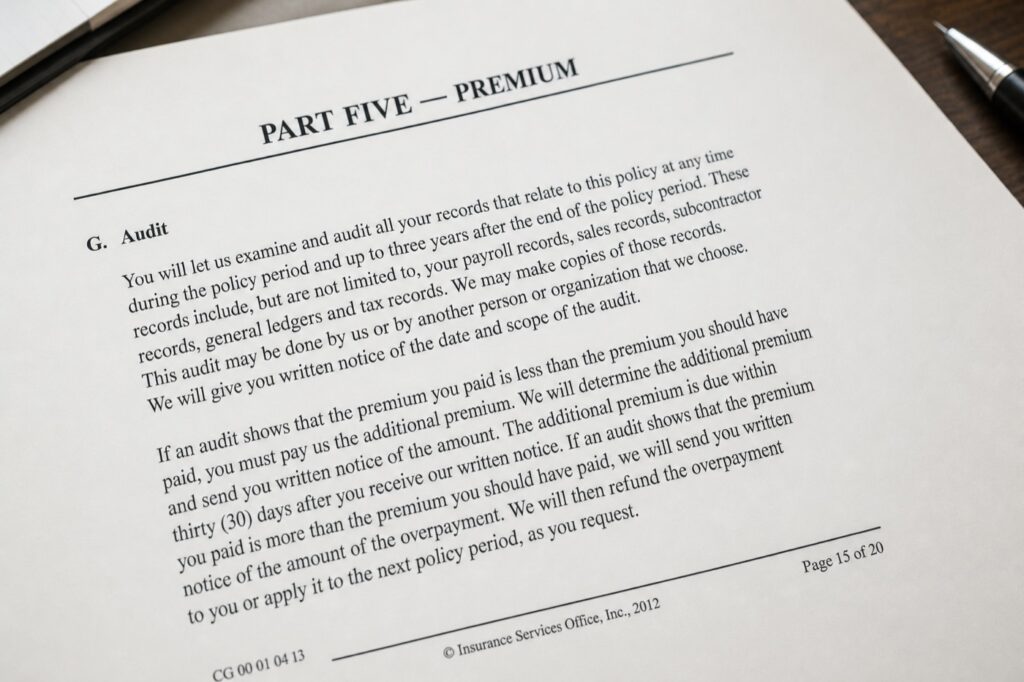
Section G (Audit) as it appears in a standard workers’ compensation policy.
Your premium is often an estimate based on projected payroll. The audit reconciles that estimate with your actual payroll and operations. Section G of your policy gives the carrier the right to examine the records needed to do that.
The documents we request — payroll records, tax reports (941s, DE-9s), general ledgers, and disbursement records — each verify a different part of your actual exposure. Without them, the carrier cannot confirm you paid the correct premium.
If your actual payroll was lower or higher than estimated, a complete audit helps to ensure that the actual premium is charged.
In most states in most standard policies, Part Five — Premium, Section C. Remuneration, Paragraph 2:
C. Remuneration
This premium basis includes payroll and payments to all other workers during the policy period for the services of:
1. all your officers and employees engaged in work covered by this policy; and
2. all other persons engaged in work that could make us liable under Part One (Workers Compensation Insurance) of this policy. If you do not have payroll records for these persons, the contract price for their services and materials may be used as the premium basis. This paragraph 2 will not apply if you give us proof that the employers of these persons lawfully secured their workers compensation obligations.
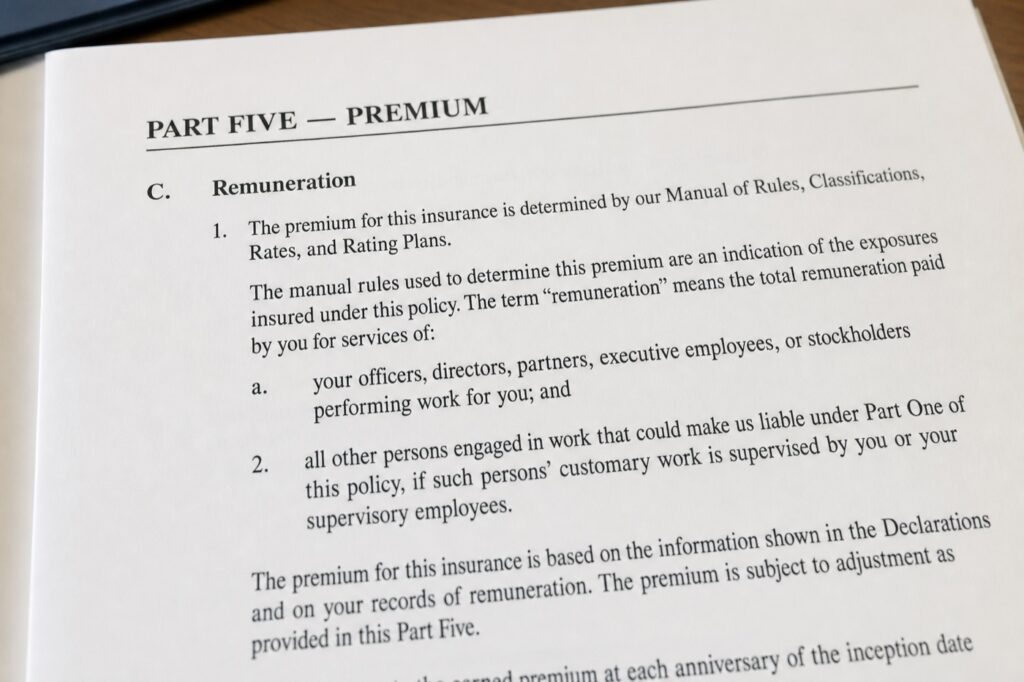
Section C (Remuneration), Paragraph 2 as it appears in a standard workers’ compensation policy.
Your policy doesn’t just cover your W-2 employees. Section C(2) extends the premium basis to anyone engaged in the work who could trigger a workers’ comp claim under your policy — including uninsured subcontractors.
However, if you provide proof that your subcontractors carried their own workers’ comp coverage, their payments are excluded from your premium. That proof is a Certificate of Insurance (COI).
That’s why we ask for profit and loss statements, vendor reports (to see what you paid subcontractors) and COIs (to confirm they had their own coverage).
Our Customer Service Team is here to help — 800 calls a week, in 11 languages.